
Noonum Update: Finding Better Peer Companies
One of our customers asked whether Noonum’s knowledge engine could help them discover similar companies. Here’s a brief story of how we turned that request into a market-ready feature: Peer Companies.
Current Industry Methodologies
From our research, investors typically identify comparable companies, or “comps,” by looking for businesses with similar industry classifications, business models, size, growth profiles, and profit margins.
But the results can vary widely across platforms. We reviewed peer lists for Amazon from several well-known brokerage, asset-management, and consumer-facing platforms. Many didn’t include Walmart, despite its clear overlap with Amazon’s retail business. Some also missed Microsoft and Google, even though Amazon Web Services (AWS) makes cloud computing an important part of Amazon’s business.
That raises a question: Is there a better way to identify meaningful peers?
A More Nuanced Approach
Noonum’s knowledge engine can analyze a company’s products and services, business segments, themes, and other business characteristics. By combining that understanding with segment-level revenue, we can identify relevant peers for each part of a company’s business.
The approach resembles a nearest-neighbor analysis. But instead of relying only on traditional financial or industry classifications, it considers the language used to describe what a company does, including both its exposures and its products and services. Peers are then ranked by their relevance to each segment and the segment’s importance to the overall business.
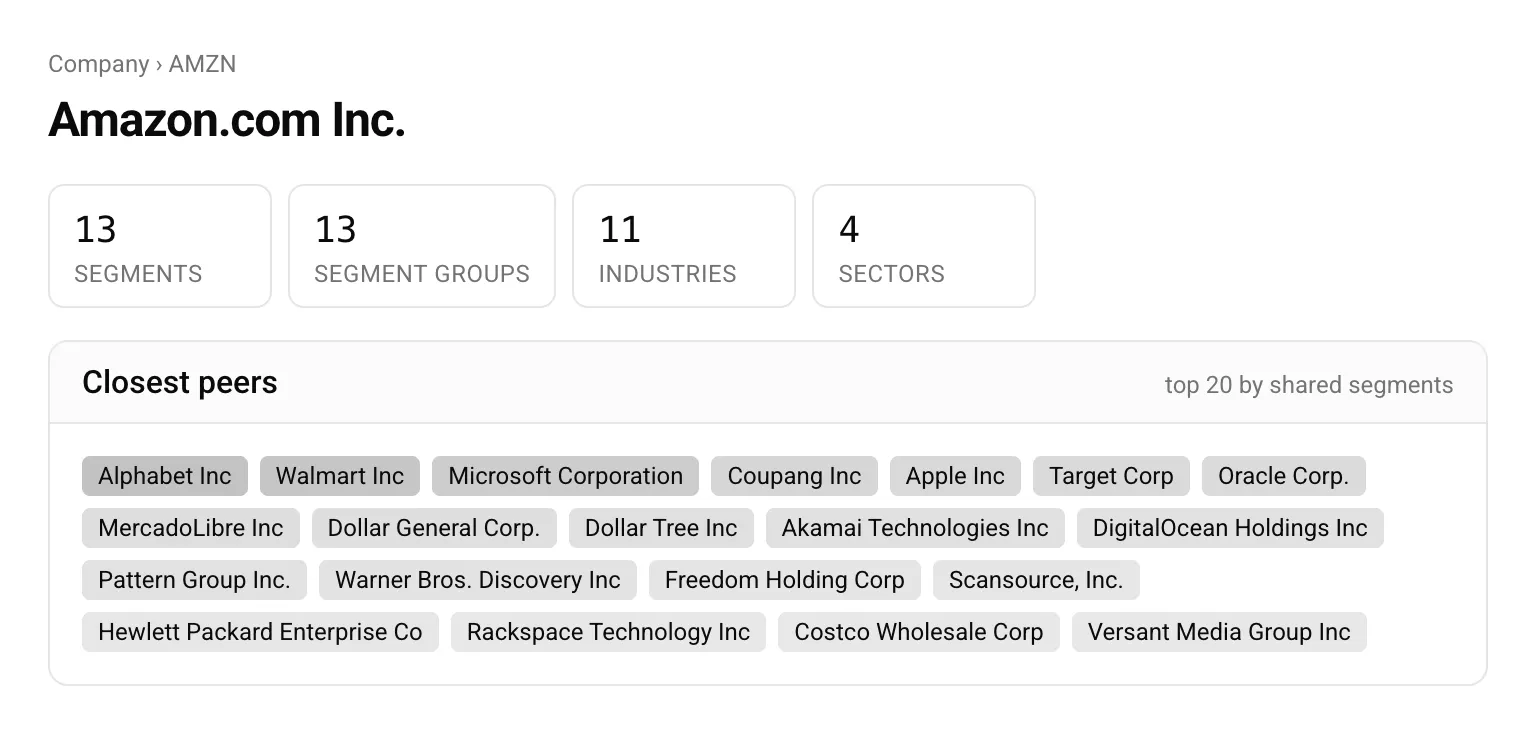
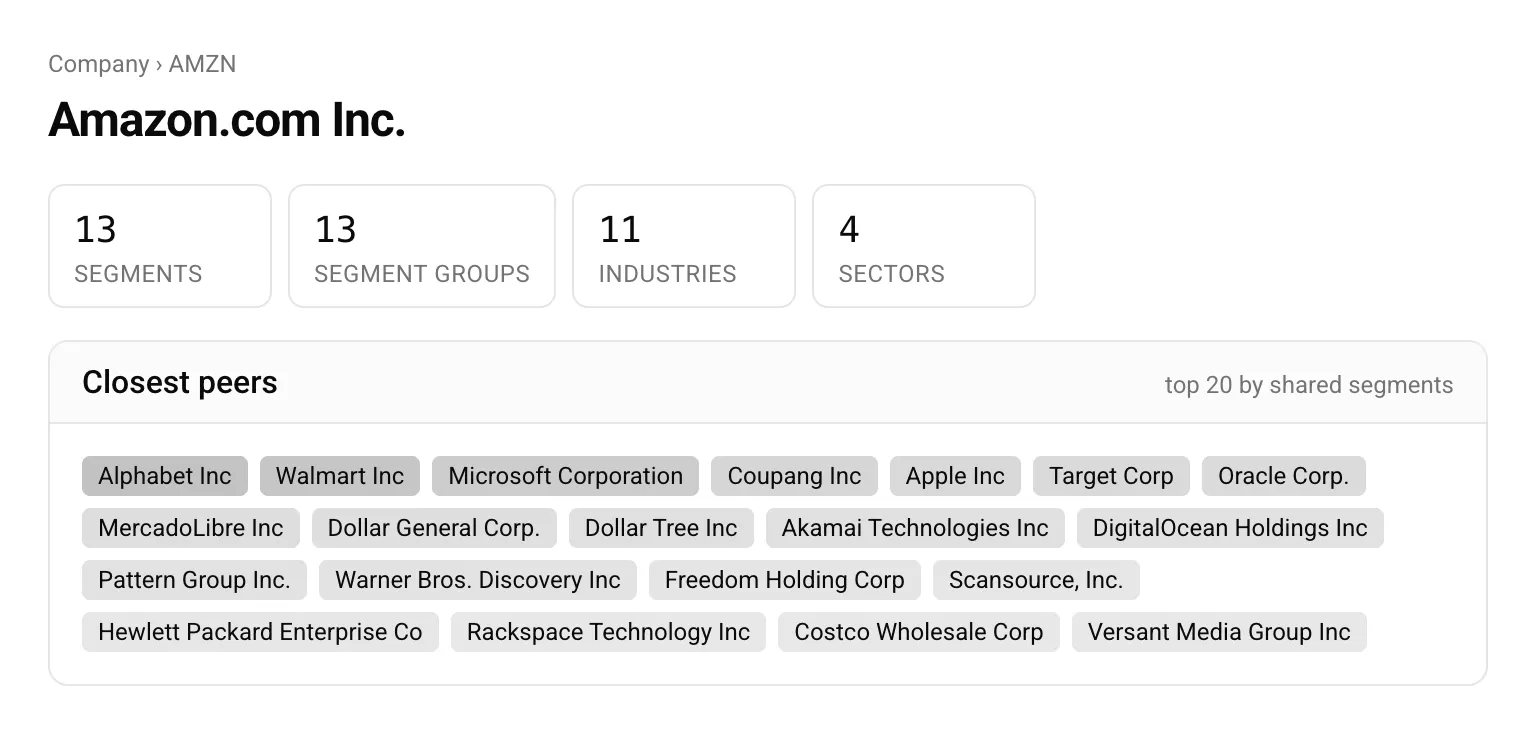
Here’s Noonum’s view of Amazon’s peer companies traded in the United States:
Looking Beyond the Overall Peer List
An overall peer list is useful, but investors may want to dig deeper. A company can operate across several distinct markets, and its most relevant peers may differ from one segment to another.
Noonum’s knowledge engine identifies Amazon as operating across 13 business segments, 11 industries, and four sectors. Exploring the peer groups within each of those sectors offers a more detailed view of the companies that overlap with Amazon, and where that overlap occurs. As with the overall list, the results include only companies traded on U.S. stock markets.
Take Consumer Discretionary, home to Amazon’s retail business. Each segment comes with its own group of peers:
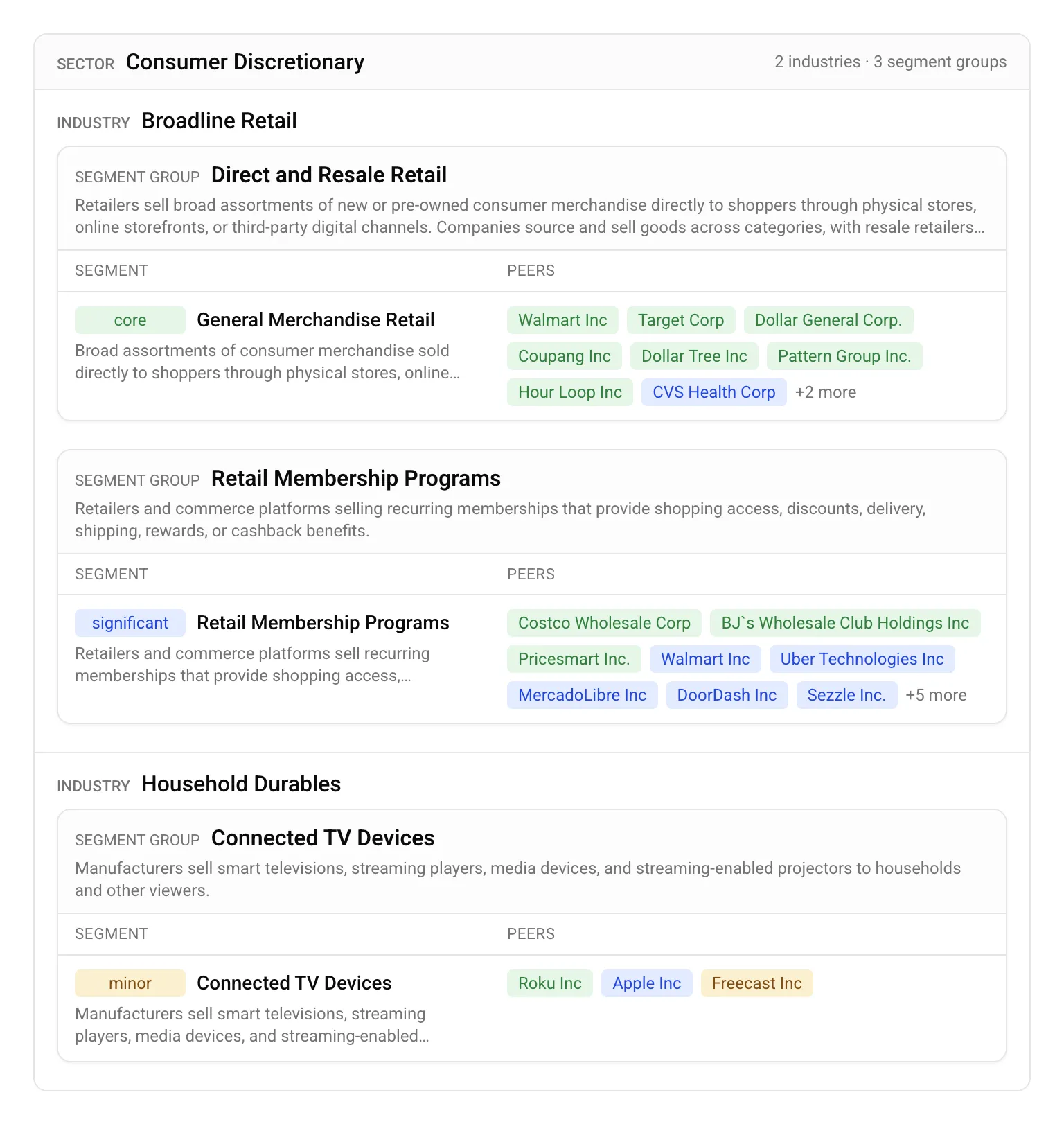
Amazon’s segments and peers in Consumer Discretionary
The same view is available for Amazon’s other three sectors. Here are their industries and segments, each segment with its own peer group to explore in the dashboard.
| Sector | Industry | Segment |
|---|---|---|
| Information Technology | IT Services | Cloud Infrastructure Services |
| Communications Equipment | Wi-Fi Networking Equipment | |
| Software | Media Content Software | |
| Technology Hardware, Storage & Peripherals | Consumer Audio Equipment, Computers and Tablets | |
| Communication Services | Entertainment | Video Streaming Services |
| Interactive Media & Services | Online Consumer Marketplaces | |
| Media | Digital Advertising | |
| Industrials | Air Freight & Logistics | E-commerce Fulfillment |
| Commercial Services & Supplies | Home Security Systems |
Beyond Conventional Classifications
Peer analysis based on a company’s language, themes, business model, products, and services can reveal connections that conventional classifications may overlook. That’s one way to put Noonum’s knowledge engine to work.
Try Peer Companies at dashboard.noonum.com.