
Point-in-Time (PiT) Intelligence for Institutional Investors
AI is everywhere in financial services today. But for institutional investors, not all AI is created equal.
In our recent conversations with clients and prospects, one theme has come through clearly: Point-in-Time (PiT) capability is a true differentiator. It’s not a “nice to have.” It’s essential.
At Noonum, PiT is not a feature layered on top of our system. It’s foundational to how we operate, and it’s one of the key reasons our offering stands out.
The Institutional Standard: Deterministic, Repeatable Results
Institutional workflows demand rigor. Any AI integrated into portfolio construction, risk management, or research must deliver:
-
Repeatable outputs
-
Deterministic behavior
-
Auditability
-
Historical consistency
This is already challenging for general-purpose large language models (LLMs) such as Anthropic’s Claude, OpenAI’s ChatGPT, and others. These models are probabilistic by design. The same input can produce slightly different outputs across runs. For exploratory use cases, that’s acceptable. For institutional investing, it’s not.
Now add another layer of complexity: accurate Point-in-Time outputs.
It’s one thing to generate an investment basket and companies aligned to it. It’s another to generate those outputs as they would have been known at a specific historical date, using only information available at that time. That is exponentially harder.
What True Point-in-Time Means
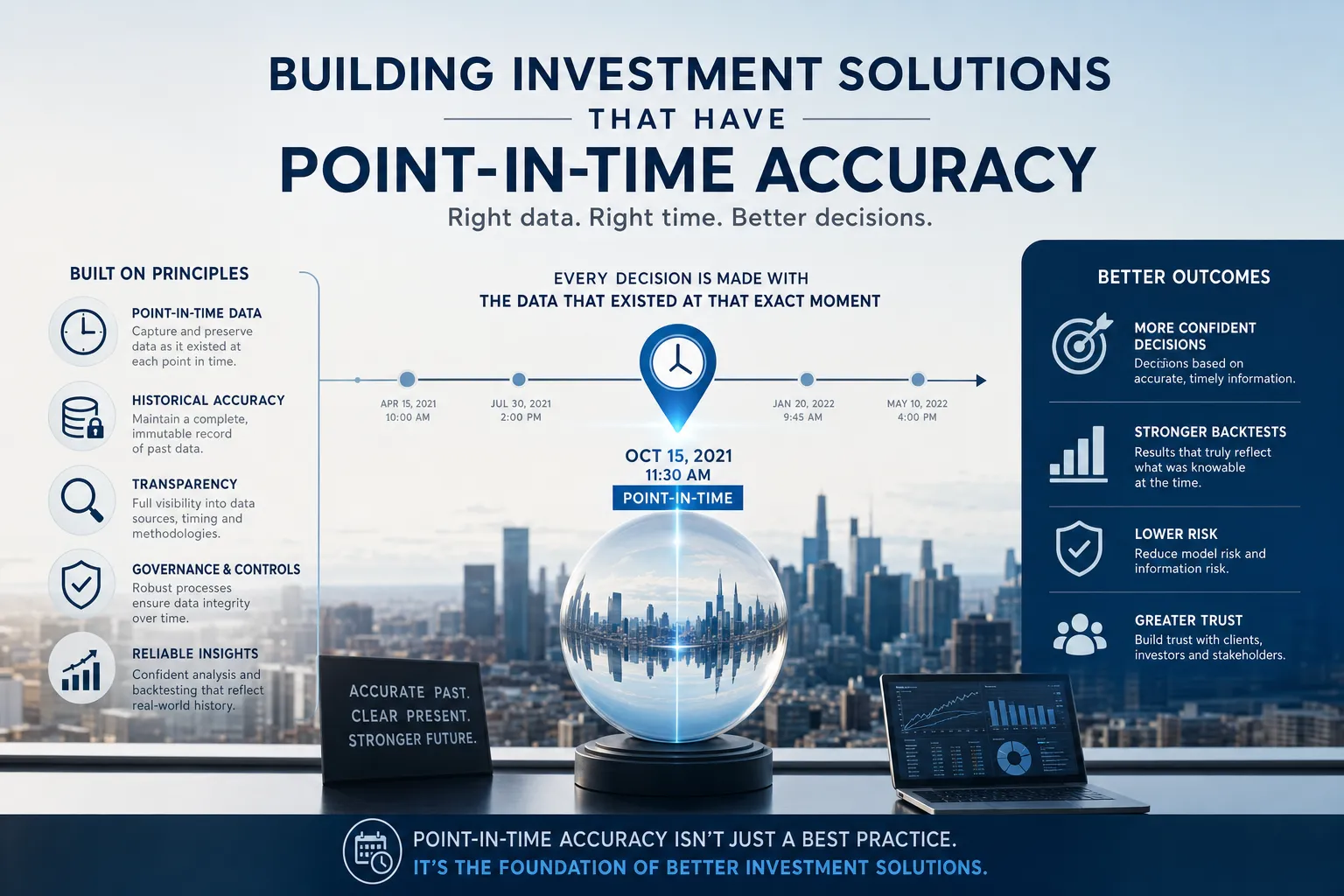
PiT is often misunderstood. It’s not just about having historical data. It’s about ensuring that every element in the analytical chain reflects what was knowable at that exact moment.
At Noonum, PiT runs deep across our entire architecture:
-
PiT information sources (120K+ articles everyday)
-
PiT language understanding (10+ years)
-
PiT company data (150K+ companies)
-
PiT securities (1M+)
-
PiT macro inputs (e.g., exchange rates and other market variables)
These elements are integrated into a unified system designed to eliminate look-ahead and forward biases.
The result? An unmatched ability to construct a global universe of companies aligned with your thesis and investment objectives, fully backtestable with history going back to 2015.
You’re not just seeing what works today. You’re seeing what would have worked then.
Moving Beyond “Gen 1” and “Gen 2” Themes
Thematic investing is lagging most investors’ expectations. Most offerings fall into what we call:
-
Gen 1 themes – Based on traditional industry classifications.
-
Gen 2 themes – Slightly more refined but still tethered to static taxonomies and seeking only pure-play exposures.
Both approaches share the same weakness: they are slow to evolve, and they are outdated relatively quickly. Industry classifications were not designed to capture rapid commercial innovation.
Modern companies are multi-layered. They operate across sectors. They pivot or reinvent themselves. They embed new technologies into legacy business models. Static classifications struggle to keep up.
Noonum takes a different approach. We identify emerging themes by understanding how companies describe and evolve their commercial activities. We are not constrained by industry labels. Instead, we use proprietary linguistic metrics to:
-
Convert relationships embedded in language across diverse sources
-
Quantify innovation and thematic exposure
-
Generate signals compatible with institutional workflows
Language is not just narrative. It is data. When structured correctly and treated in a Point-in-Time framework, it becomes a powerful quantitative input.
Capturing Emerging Themes in Real Time: AI Power & Energy
A recent case study illustrates this approach.
Over the past year, the rapid rise of AI-driven demand for power and energy infrastructure has transformed segments of the market. Traditional classifications did not immediately reflect this shift. Many companies driving or benefiting from the trend were not labeled as “AI” or “Energy transition” plays in conventional datasets.
Noonum’s PiT linguistic framework detected the shift as it was happening:
-
Increasing commercial references to AI-linked power demand
-
Expanding infrastructure commitments
-
Evolving supply chain dependencies
-
Geopolitical and macroeconomic implications
From both a language signal and a returns standpoint, we captured the emergence of the AI Power & Energy theme as it developed and not retroactively.
Because our system is fully Point-in-Time, we can demonstrate exactly when the signal strengthened, how the investable universe grew, and how it would have performed in real time.
Why PiT is a must for Institutional AI
As AI becomes more integrated into investment workflows, institutional standards will only tighten. Fiduciary-responsible institutional investors requiring regulatory approvals for their solutions need systems that are:
-
Transparent
-
Deterministic
-
Backtestable
-
Free from look-ahead bias
-
Fully Point-in-Time
At Noonum, we’ve built our platform with these principles from day one. PiT isn’t a marketing term for us. It’s a structural commitment.
In a world flooded with AI-generated insights, the real edge comes from knowing not just what the model says, but what it would have said, and known, at the time.
That difference matters.