
Linguistic Strength Indicator (LSI)
From Buzz to Billion Dollar Trends
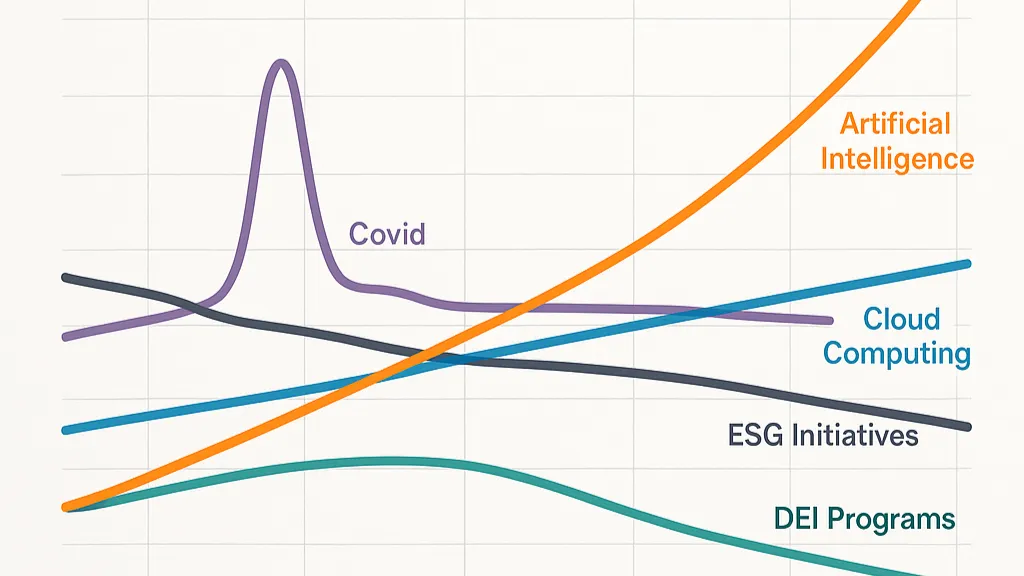
From the rise of Artificial Intelligence to the chaos of Covid, from the AI explosion to today’s geopolitical shocks—new trends often emerge without warning. They disrupt industries, shift consumer behavior, and move markets. Yet, by the time these forces are reflected in financial statements or traditional metrics, the investment opportunity is often too late.
So how do we get ahead of them?
At Noonum, we believe the answer lies in language.
Introducing the Linguistic Strength Indicator (LSI)
The Linguistic Strength Indicator is a novel way to measure the momentum and durability of themes, trends, and investment ideas—purely from a linguistic perspective.
Unlike traditional classification systems like GICS or RBICS, which rely on backward-looking financial data, LSI captures how frequently, intensely, and consistently a comprehensive universe of companies is talking about a trend before it turns into a revenue line item.
Think of it as early thematic radar.
Fad or Fab?
Emerging themes often begin as noise—but some become megatrends. LSI helps answer:
- Is a trend gaining linguistic traction across companies?
- Are more firms starting to talk about it?
- Is the language around the theme becoming more coherent?
- Is the trend translating into broader supply chain and ecosystem signals?
These are powerful signals—especially when time-stamped and tracked.
LSI vs. Linguistic Beta
Previously, we introduced Linguistic Beta—a company-level measure of alignment to a theme or an investment objective. While Linguistic Beta shows how exposed a company is to an idea, LSI aggregates that across the market to show how strong or durable the opportunity itself is.
Used together, they’re a powerful pair: one zooms in, the other zooms out.
Why It Matters
The Linguistic Strength Indicator (LSI) equips investors and strategists with a quantitative metric to understand the rise and fall of themes and trends —before they become fully priced in. Viewed as a time series, LSI reveals the momentum curve of a trend: is it building, peaking, or fading?
When combined with the market cap and/or stock prices of the companies, LSI becomes even more powerful—offering a view into the topic’s evolving Total Addressable Market (TAM) & Thematic Beta.
Traditionally, investors have relied on sector rotation to shift capital as economic cycles unfold. Now, theme rotation becomes the next frontier—enabling a more nuanced and dynamic strategy across ETFs, mutual funds, SMAs, and UMAs.
But LSI goes beyond portfolio construction. It’s a strategic intelligence tool for:
- Capital allocation within a firm
- Product roadmap alignment to macro narratives
- M&A targeting, based on emerging adjacency signals
By quantifying how language shapes markets, LSI offers a new lens into risk, opportunity, and competitive positioning—one that financial metrics alone often miss.
LSI vs. RSI: A New Kind of Strength
For decades, investors have used the Relative Strength Index (RSI) to gauge momentum based on price action—identifying when an asset is overbought or oversold. RSI is grounded in technical analysis, relying on past performance to signal potential reversals or continuations.
But in a world of accelerating change, prices often react too late.
Enter the Linguistic Strength Indicator (LSI)—a modern momentum signal that doesn’t wait for the market to catch up. Instead of analyzing past prices, LSI reads the language that companies use in filings, earnings calls, and disclosures to assess the strength of emerging ideas and topics.
Where RSI tells you how hard an asset has been bought or sold, LSI tells you how fast an idea is spreading.
| RSI | LSI | |
|---|---|---|
| Type | Price-based momentum | Language-based momentum |
| Signal Source | Historical price data | Corporate disclosures, filings, transcripts |
| Use Case | Timing asset entry/exit | Tracking trend durability and adoption |
| Frequency | Short-term (days/weeks) | Medium- to long-term (weeks/months/years) |
| Perspective | Security-specific | Topic or trend-specific |
In the investing world, where investors care more about “AI adoption” or “supply chain resiliency” than just tech or industrial sectors, LSI is less about what has already happened, and more about what’s beginning to take shape.
In short:
RSI tells you when to trade.
LSI tells you what to believe in.
Language as Alpha or to Manage Risks
We believe that quantifying language is the next frontier in finance.
In a few years, linguistic metrics like LSI may sit alongside revenue and profit as essential metrics for institutional and retail investors alike.
At Noonum, we’re so excited to be offering these next generational capabilities.