
The Rapid Rise of AI Power and Energy
In fifteen months, the number of companies whose language aligns with AI Power and Energy grew from 269 to 501. The total linguistic signal behind the theme rose 82%. And the companies leading that language shift outperformed the S&P 500, the utility sector, and even the dedicated AI-power ETFs built to capture exactly this trade.
In our previous piece, we showed that Power and Energy was the top-performing AI sub-theme of the past year, returning 264%, and that almost no AI ETF owned it. That analysis was a snapshot. This one is a film.
We took Noonum’s Linguistic Beta scores for the AI Power and Energy theme and tracked them month by month from January 2025 through March 2026. Then we matched the language data against actual share prices. What emerged is a clear story about how a theme is born, how it broadens, and how language and returns move together as a narrative takes hold.
How We Measured It
Linguistic Beta measures how strongly a company’s public language, drawn from its filings, earnings calls, and press releases, aligns with a given investment theme. A score of 0.30 means roughly 30% of what the company is talking about maps to the AI Power and Energy thesis.
We use two measures throughout. Linguistic Beta is the per-company score. The Linguistic Signal Index, or LSI, is the sum of every constituent’s Linguistic Beta on a given date. The LSI rises when more companies join the theme, when existing members talk about it more intensely, or both. Tracking the two together tells us whether a theme is broadening, deepening, or fading.
Linguistic data covers January 2025 to March 2026. Price data covers June 2025 to June 2026. Where we compare language to price, we use the overlapping window and note it.
Finding 1: The Theme Nearly Doubled in Breadth
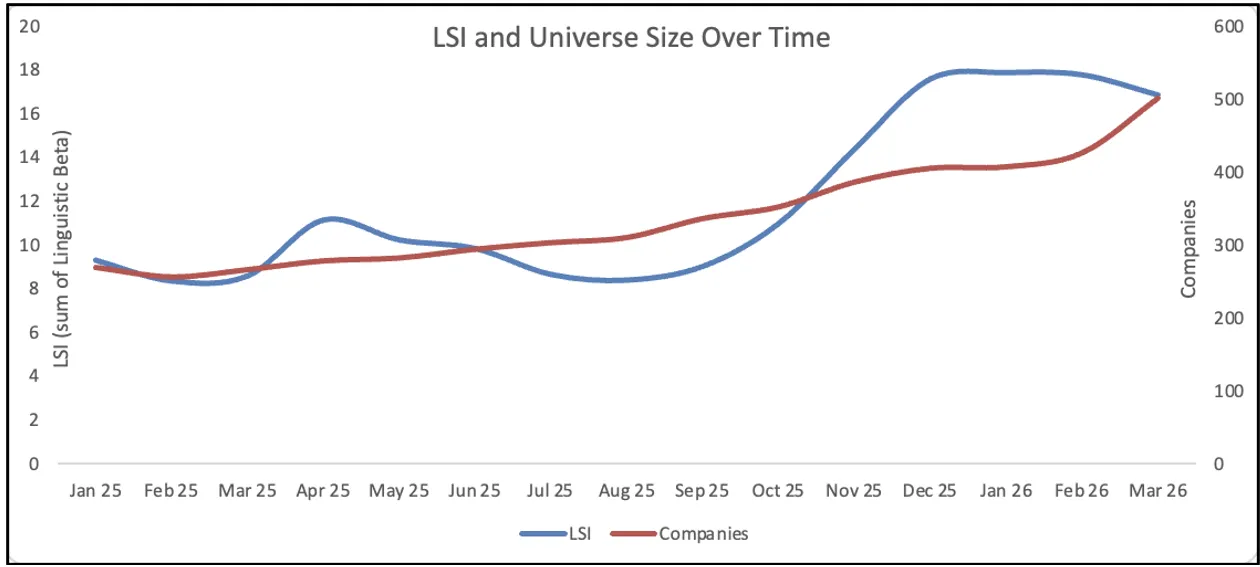
In January 2025, 269 companies carried meaningful AI Power and Energy language. By March 2026, that number was 501. An 86% expansion in fifteen months.
The single largest jump came in March 2026, when 75 new companies entered the theme in one month. This was not a handful of obvious data-center names. It was a broad wave of utilities, grid-hardware makers, cooling specialists, nuclear developers, and capital providers all beginning to describe their businesses in terms of AI power demand.
Crucially, the growth came from breadth, not intensity. The average Linguistic Beta per company barely moved over the full period. The theme did not get louder per company. It got wider. More and more of the market began speaking the language of AI power.
| Metric | Jan 2025 | Mar 2026 | Change |
|---|---|---|---|
| Companies in theme | 269 | 501 | +86% |
| Linguistic Strength Indicator | 9.27 | 16.84 | +82% |
| Avg Linguistic Beta | 0.0345 | 0.0336 | -3% |
Noonum Linguistic Beta historical data. LSI = sum of Linguistic Beta across all constituents. Source: Noonum.
Finding 2: It Grew in Two Waves, Not One
The theme did not expand in a straight line. It moved through four distinct phases.
Spring surge. The LSI climbed from 9.27 in January to a local peak of 11.11 in April 2025 as the first wave of data-center power coverage hit.
Summer cooldown. From April to August, the LSI fell back to 8.36, its lowest point of the year. Attention cooled. But the universe kept quietly growing, from 278 to 310 companies. The story was being seeded even as the signal dimmed.
Autumn acceleration. From August to December, the LSI more than doubled, from 8.36 to 17.57. This was the breakout. New entrants and rising intensity compounded together as AI power became a defining market narrative.
Winter plateau. Through early 2026, the LSI held near its highs while the universe kept expanding. The theme matured from a fast-moving story into a broad, established category.
The summer dip is the most instructive part. A price-only or attention-only lens would have read it as the theme losing steam. The language data shows the opposite: the universe was still being built. The pause was a setup, not a top.
Finding 3: Language Led, and Returns Followed
When we match the language data against share prices, a consistent sequence emerges across the theme’s strongest names: the language moved first, and the price followed.
The clearest cases are striking. Liberty Energy’s Linguistic Beta climbed more than forty-fold as its language filled with AI data-center power references, while its share price had only begun to respond. CenterPoint Energy’s rose nearly thirteenfold ahead of its price move. In both, the market caught up to what the language had already flagged. Babcock & Wilcox’s Linguistic Beta surged more than fivefold in November 2025 as AI power and steam-systems language moved to the center of its disclosures, and the stock went on to a 1,483% run.
The pattern held across the spotlight set. Here are the names where rising language conviction was followed by rising prices.
| Ticker | Company | LingBeta chg | Price (overlap) | Price (full) |
|---|---|---|---|---|
| BW | Babcock & Wilcox | +583% | +1,430% | +1,483% |
| POWL | Powell Industries | +275% | +157% | +284% |
| CLS | Celestica | +555% | +80% | +133% |
| CAT | Caterpillar | +517% | +82% | +122% |
| HUT | Hut 8 | +168% | +152% | +472% |
| VRT | Vertiv | +66% | +95% | +118% |
| PWR | Quanta Services | +148% | +45% | +73% |
| NEE | NextEra Energy | +244% | +34% | +23% |
LingBeta change: Jun 2025 to Mar 2026. Price overlap: Jun 2025 to Mar 2026. Price full: Jun 2025 to Jun 2026. Source: Noonum, Yahoo Finance.
The relationship is directional, not mechanical. Across the spotlight set, rising conviction in a company’s language and rising share prices showed up together, and in a meaningful number of names the language shift was visible before the largest price move arrived. We are not claiming a leading trading signal that fires identically in every name. In some, price and language moved in the same month, and in a few prices moved first. But the weight of the evidence points one direction: where Noonum detected conviction building in a company’s own words, returns tended to follow. Linguistic Beta behaved as an early read on where the theme’s returns were about to concentrate.
Finding 4: The Signal Beat the Market
A fair challenge to any thematic story is whether the names simply rose because everything rose. They did not.
Over the same window, the S&P 500 returned 18% and the utility sector just 8%. The spotlight names, the ones where Noonum identified rising AI-power language, broadly left those benchmarks behind. Even against the dedicated thematic ETFs, the signal held its own.
| Ticker | Benchmark | Return | Window |
|---|---|---|---|
| AIPO | Defiance AI & Power Infrastructure ETF | +44% | Jul25-Jun26 |
| XLE | Energy Sector | +38% | Jun25-Jun26 |
| GRID | First Trust Clean Energy / Grid ETF | +31% | Jun25-Jun26 |
| QQQ | Nasdaq 100 | +26% | Jun25-Jun26 |
| SPY | S&P 500 | +18% | Jun25-Jun26 |
| XLI | Industrials Sector | +16% | Jun25-Jun26 |
| XLU | Utilities Sector | +8% | Jun25-Jun26 |
Total return over the window shown. AIPO measured from its July 2025 launch. Source: Yahoo Finance.
Several spotlight names, from Babcock & Wilcox to Powell Industries to Hut 8, returned multiples of even the best-performing benchmark. The language was not pointing at the market. It was pointing at the specific companies inside the theme that were about to move.
Finding 5: NextEra Is the Clean Case Study
No company illustrates the arc better than NextEra Energy.
In January 2025, NextEra’s Linguistic Beta against the AI Power and Energy theme was 0.019. By March 2026 it was 0.089, a 368% increase. This was not a spike. It was a steady, compounding climb, accelerating sharply from September 2025 onward as the company’s disclosures shifted from general utility language to explicit AI data-center power contracting.
As the language built, NextEra’s weight in the theme index more than doubled. The company was becoming semantically central to AI power, not because a sector label changed, but because what NextEra itself was saying changed. Over the price window, the shares rose 23%, ahead of the 8% return of the broad utility sector it belongs to.
NextEra is a large, widely held, heavily covered utility. The fact that Noonum captured its pivot into the AI power story in real time, from the company’s own words, is the clearest demonstration of what language-based measurement does that sector classification cannot.
Finding 6: Babcock & Wilcox, From Penny Stock to Theme Bellwether
If NextEra shows how a large incumbent absorbed the AI power narrative, Babcock & Wilcox shows how the theme transformed a forgotten small-cap.
In early 2025, Babcock & Wilcox was a sub-dollar stock with a Linguistic Beta of 0.006 against the AI Power and Energy theme, a marginal name carrying barely a trace of the language. By March 2026 its Linguistic Beta had risen to 0.053, an 812% increase, and its weight in the theme index had grown roughly fourfold.
The trajectory is a story of mutual reinforcement. Through the summer of 2025, as the company’s energy-systems and power-generation commentary began to reference AI-driven demand, its shares started to climb off their lows, from under a dollar in June to $3.61 by October. Then came the breakout. In November 2025 the company’s Linguistic Beta jumped more than fivefold in a single month, from 0.004 to 0.030, as AI data-center power and steam-systems language moved to the center of its disclosures. The share price moved with it, reaching $6.25. From there the two climbed together, with Linguistic Beta peaking near 0.055 in January 2026 and the stock continuing to $14.69 by March and on toward $18 by May.
The full-window return was extraordinary: a 1,483% gain, the largest of any name in our spotlight set and many multiples of even the best-performing benchmark. Babcock & Wilcox would never have appeared in an AI ETF screener. It is classified under Electronic Technology, trades as a small-cap, and carried almost no AI-power language at the start of the period. Noonum identified its emergence the only way it could be identified at the time: by reading what the company was actually saying about its place in the AI power buildout, month by month, as that story took hold.
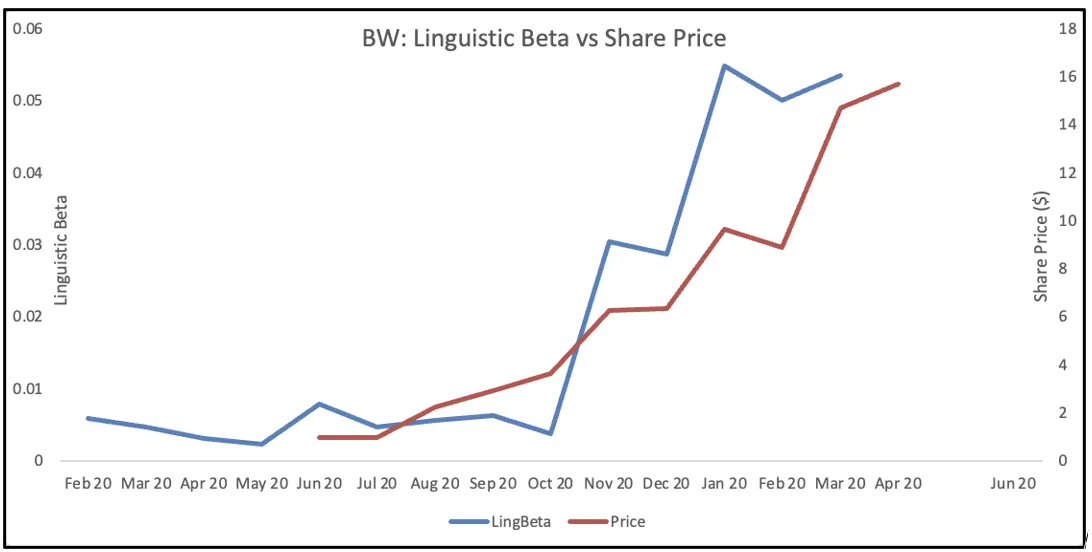
Babcock & Wilcox (BW), monthly. Linguistic Beta and index weight from Noonum; share price month-end close. Source: Noonum, Yahoo Finance.
Finding 7: The Early Pure-Plays Faded
Not every early leader held its position. The theme’s maturation reshuffled who defined it.
In January 2025, the highest Linguistic Beta in the entire dataset belonged to SAIHEAT, a small data-center cooling and infrastructure name. By March 2026 its score had fallen 51% as larger, more established companies entered and came to dominate the signal. Talen Energy, a high-profile nuclear-power name early on, saw its Linguistic Beta fall 30% as the specific deal language that drove its early score normalized.
This is what a maturing theme looks like. The first companies to speak a new language are often small and speculative. As the theme proves real, the heavyweights move in, and the center of gravity shifts from the pioneers to the incumbents. Tracking Linguistic Beta over time captures that handoff as it happens.
What This Means
AI Power and Energy went from a niche idea to a 501-company theme in fifteen months. The language data did not just confirm that growth after the fact. It tracked the theme broadening through a summer when prices and attention suggested it was cooling, and it identified the specific companies whose conviction, measured in their own words, was rising fastest, before and alongside their largest price moves.
For allocators and investors, three implications follow.
Themes are built in the quiet periods. The summer 2025 cooldown looked like fading momentum on a price chart. In the language, the universe was still expanding. Watching how a theme broadens, not just how it performs, gives an earlier read on whether it is real.
Conviction in language and returns are linked. Across this theme, the companies whose Linguistic Beta rose most were the companies whose shares rose most. That relationship is a map of where genuine thematic exposure is concentrating.
The leaders of a theme change over time. Early pure-plays gave way to established incumbents like NextEra. A static holdings list misses this rotation. A live language signal captures it.
The companies powering AI are still being identified, in their own words, month by month. That is the process Noonum was built to measure.
Three limitations are worth stating directly. The linguistic and price windows do not fully overlap, so cross-measure comparisons use the common period from June 2025 onward. The relationship between Linguistic Beta and returns documented here is contemporaneous association, not a tested predictive or causal signal. And the spotlight set, while broad, is a selection of the theme’s most notable names rather than its full 501-company universe. Future work using point-in-time scores across the entire universe and a longer history would strengthen these findings.
About Noonum
Noonum is an AI agent that builds language-based analytics to measure how aligned any company or portfolio is to a given investment objective. Rather than relying on sector classifications or price data, Noonum quantifies the actual language companies use in filings, transcripts, press releases, and news to score exposures to any given investment objective, construct indices and optimized portfolios, and let investors compare their portfolios against any investment lens they choose. noonum.ai
This report is published by Noonum for informational and research purposes only. It does not constitute investment advice, a recommendation to buy or sell any security, or an offer of any kind. Past performance is not indicative of future results. Linguistic data covers January 2025 to March 2026; price data covers June 2025 to June 2026. Noonum Linguistic Beta scores reflect company-level thematic alignment derived from filings, earnings transcripts, and press releases. Copyright 2026 Noonum. All rights reserved. noonum.ai