
Power and Energy Was the Top AI Sub-Theme of the Year. Most ETFs Owned Almost None of It
Power and Energy was the top-performing AI sub-theme of the past year. It returned +264%. Not a single mainstream AI ETF meaningfully owned it.
In our first piece, we showed that the AI ETF label tells you almost nothing about how a fund actually performs. The variable that mattered was which slice of Jensen Huang’s five-layer AI cake the fund owned. Apps and Services, where most pure AI ETFs are concentrated, returned 13%. Power and Energy returned 264%.
This piece is entirely about that gap. Not about chatbots or software. About the physical infrastructure that makes all of AI possible, why conventional investment tools failed to identify it, and what Noonum’s language-based methodology surfaces that sector classification systems cannot.
What is Power and Energy AI?
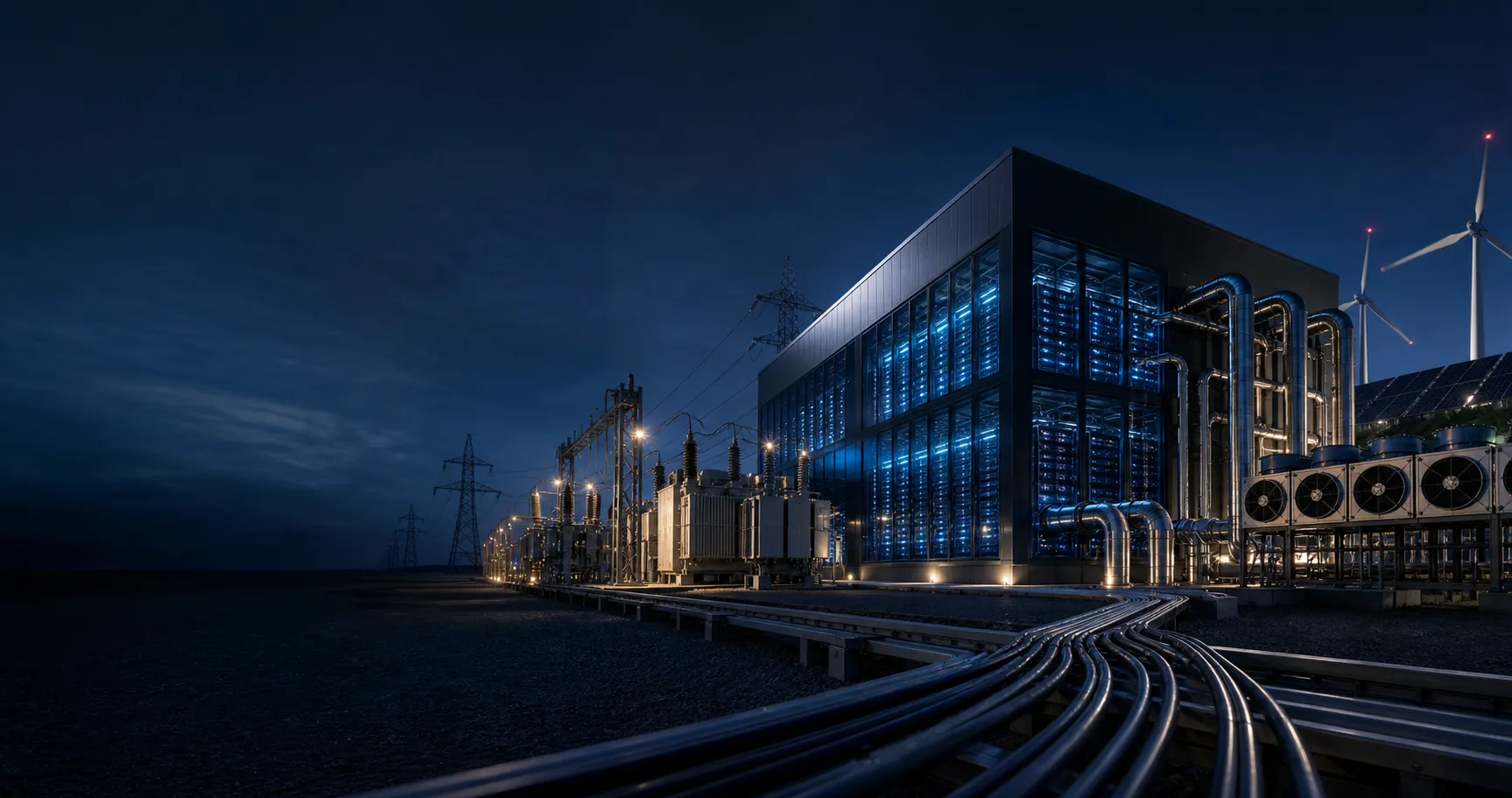
AI runs on electricity. A lot of it. A single modern AI data center can consume as much power as a small city. The new generation of AI servers generate so much heat that traditional air cooling is no longer physically adequate. They need liquid cooling systems, purpose-built facilities, and massive amounts of reliable, around-the-clock power.
The companies building this infrastructure form the Power and Energy AI sub-theme. Noonum’s index comprises 301 constituents with an aggregated market capitalization of $24.4 trillion. It is built around a single structural thesis: the full power-delivery stack required to sustain AI-intensive data centers running continuously at densities exceeding 100 kW per rack.[3]
| Sub Sector | Index Weight | What it means | Example companies |
|---|---|---|---|
| Secure Power Utilities and Generation | 35% | Power plants signing electricity deals with AI data centres | Constellation Energy, Vistra, NextEra Energy, Ormat |
| Grid Hardware and Power Electronics | 28% | Transformers and switchgear handling massive new electricity loads | Schneider Electric, Eaton, ABB, GE Vernova, Prysmian |
| Data Centre Cooling and Infrastructure | 22% | Systems cooling AI servers running at 10x normal heat levels | Vertiv Holdings, Asetek, Modine, Asia Vital, Daikin |
| Strategic Investors and Energy Logistics | 15% | Capital deploying into the AI power buildout | Brookfield, Kinder Morgan, Enbridge, Blackstone, KKR |
Source: Noonum Power and Energy AI Sub-Theme Factsheet, March 2026.[3]
The numbers
+264% Noonum Power and Energy index, May 2025 to May 2026. The top AI sub-theme by return.
To put that in context, here is how every AI sub-theme performed over the same twelve months:
| AI Layer | 1-Year Return | Rank | Key driver |
|---|---|---|---|
| Power and Energy | +264.0% | 1 | Data center power demand; nuclear, grid hardware, liquid cooling |
| Chips and Compute | +169.9% | 2 | Semiconductor supply for AI training and inference workloads |
| Cloud and Infra | +168.3% | 3 | Hyperscaler AI infrastructure; data center networking |
| Models and Data | +41.3% | 4 | LLM development; data platforms and analytics providers |
| Apps and Services | +12.7% | 5 | Consumer and enterprise AI software; SaaS AI integration |
Noonum AI sub-theme strategy index returns, May 2025 to May 2026. Not investable products. Source: Noonum.[3]
+264% against +13%. That is the gap between the top and bottom AI layer last year. Power and Energy beat Apps and Services, where most pure AI ETFs are concentrated, by 251 percentage points. The five-layer cake did not return evenly.
Why did almost nobody own it?
Because the companies powering AI are not classified as AI companies.
When a fund manager builds an AI ETF, they typically start with companies in the Technology sector. That is what gets labeled as AI. But the companies enabling the AI buildout at the infrastructure level do not carry that label:
| Company | What it does for AI | Standard sector label |
|---|---|---|
| Constellation Energy | Provides nuclear power to AI data centres under long-term contracts | Utilities |
| Vertiv Holdings | Makes the liquid cooling systems inside NVIDIA AI servers | Electrical Equipment |
| Schneider Electric | Manages power distribution for data centre campuses | Industrial Conglomerates |
| Equinix | Runs the physical data centres that AI lives inside | Real Estate (REIT) |
| ABB | Builds the transformers handling AI’s massive grid load | Heavy Electrical Equipment |
| GE Vernova | Supplies gas turbines and grid equipment for AI campus power | Industrials |
None of these often appear in an AI ETF screener. They are invisible to any classification system built before the data center power crisis existed. Noonum’s methodology is different. Instead of using sector labels, it reads what companies actually say in their earnings calls, filings, and press releases, and measures how closely that language aligns with an AI investment theme. Vertiv’s Linguistic Beta score against the Power and Energy theme is 33.22%. That number comes directly from the company’s own words about AI-grade power conditioning and liquid cooling. No label required.
There are three structural reasons conventional AI ETFs missed this entirely:
GICS classification misalignment. The companies comprising the Power and Energy AI theme are predominantly classified as Utilities, Industrials, or Real Estate. AI ETFs built on sector screens exclude these categories by construction.
Mandate narrowness. AI ETF mandates reference artificial intelligence, machine learning, robotics, and automation. The physical infrastructure enabling these technologies falls entirely outside those mandates. The funds were designed to capture the software story, not the infrastructure buildout required to sustain it.
Atypical inclusions. The Noonum Power and Energy index includes companies that would never appear on an AI investor’s radar: integrated oil majors (Chevron, ExxonMobil, TotalEnergies) with gas networks and dedicated power plants for hyperscale campuses; aerospace and industrial conglomerates (GE Aerospace, Rolls-Royce) with small modular reactor intellectual property; and large alternative asset managers (Brookfield, Blackstone, KKR) deploying over $250 billion into energy-transition vehicles that overlap directly with AI power buildouts. All of them are shaping the funding, fuel supply, and technology pathways that will determine future AI power availability.
The core issue: identifying Power and Energy alignment requires reading what companies actually say about their relationship with AI infrastructure. Sector classification systems built before the data center power crisis simply do not have a category for it.
How much Power and Energy did each ETF actually own?
Across the eight ETFs in our prior study, average Power and Energy alignment was 2.3%. No fund exceeded 4.0%. The range from highest to lowest was less than four percentage points. For practical purposes, every fund in the study was equally unexposed to the sub-theme that returned 264%.
| ETF | Power and Energy Alignment | 1-Yr Return | Gap to theme return |
|---|---|---|---|
| FDN | 3.96% | +12.8% | -251pp |
| QQQ | 3.34% | +45.8% | -218pp |
| IGM | 2.74% | +60.8% | -203pp |
| XT | 2.57% | +30.7% | -233pp |
| AIQ | 2.36% | +51.5% | -213pp |
| QTUM | 1.97% | +74.8% | -189pp |
| FTEC | 1.85% | +58.0% | -206pp |
| SMH | 0.02% | +153.6% | -110pp |
| P&E Theme Index | 100% | +264.0% | Benchmark |
Power and Energy alignment from Noonum Linguistic Beta scores, holdings as of May 1, 2026. Returns: May 2025 to May 2026. AIPO is provided as reference only and was not included in the study due to limited price history. pp = percentage points. Source: Noonum, Yahoo Finance.[1][5]
The variance across funds is so small as to be meaningless. Every fund effectively had zero Power and Energy exposure during the period in which the sub-theme returned 264%. This is not a near-miss. It is a systematic exclusion built into how AI ETFs are constructed.
But wait. What about AIPO and DRAM?
Fair question, and worth addressing directly rather than burying in a footnote.
AIPO (Defiance AI and Power Infrastructure ETF) launched in July 2025 and was named Best New Thematic ETF at the 2026 ETF.com Awards.[1] By May 2026 it had grown to approximately $750 million in AUM. That is a meaningful early signal that some part of the market is waking up to the Power and Energy story.
DRAM (Roundhill Memory ETF) launched in April 2026 and crossed $15 billion in AUM, the fastest any ETF has ever reached that milestone. DRAM tracks AI memory chip manufacturers: Samsung, SK Hynix, and Micron.[2]
But the contrast is the story. DRAM attracted $15 billion in under two months. AIPO attracted $750 million in ten months. Both track AI infrastructure themes. Institutional capital moved decisively into AI memory. It has been far slower to recognize AI power infrastructure. The gap in capital flows mirrors the gap in attention that this analysis documents.
The asymmetry: investors found the chips story fast. DRAM crossed $15 billion in 60 days. The power story is still being discovered. AIPO has $750 million after ten months. If Noonum’s Power and Energy index returning +264% over the past year is any guide, that asymmetry may prove costly.
The companies at the center of this theme
Here are the standout constituents of the Noonum Power and Energy index and what makes each one relevant to the AI power buildout:
| Company | Linguistic Beta | Market Cap | Why it matters for AI |
|---|---|---|---|
| S-FuelCell (Korea) | 68.14% | $41.4M | Highest Linguistic Beta in the entire index; fuel-cell powered data centre modules |
| Vertiv Holdings (US) | 33.22% | $93.5B | Global leader in power conditioning and liquid-cooling modules for NVIDIA AI clusters |
| Applied Digital (US) | 18.96% | $7.3B | Builds AI-dedicated compute campuses with proprietary immersion cooling; hyperscaler contracts |
| Constellation Energy (US) | 12.77% | $117.6B | Largest U.S. nuclear fleet; signed multi-gigawatt power purchase agreements with cloud providers |
| Equinix (US) | 11.12% | $94.9B | Largest neutral colocation REIT; converting facilities to liquid-cooled AI specifications |
| NextEra Energy (US) | 8.67% | $192.9B | Largest North American renewables utility; dedicated solar-plus-storage for data centre campuses |
| Oklo Inc. (US) | 5.01% | $9.9B | Designs small modular reactors for on-site nuclear power at hyperscaler campuses; first contracts signed |
| Fluence Energy (US) | 6.29% | $2.7B | Grid-scale battery integrator solving peak-shaving problems for AI campuses |
| Asetek A/S (Denmark) | 3.86% | $82.7M | Patented direct-to-chip liquid cooling widely referenced in NVIDIA and AMD reference designs |
Linguistic Beta scores from Noonum Power and Energy AI Sub-Theme Factsheet, March 2026.[3]
One company worth highlighting: Oklo Inc. is a $9.9 billion company building small modular reactors designed to sit on data center campuses and provide dedicated on-site nuclear power. Its filings are full of language about AI power demand. It would never appear in an AI ETF. Noonum’s language scoring identified it immediately from the company’s own disclosures.
What this means
Power and Energy was the top-performing AI sub-theme in the Noonum universe over the twelve months ending May 2026. Its structural composition, nuclear utilities, grid hardware manufacturers, liquid-cooling specialists, and infrastructure capital providers, sits almost entirely outside the sector classifications and mandate definitions used by conventional AI ETFs. The result is that not a single fund in this study carried meaningful Power and Energy exposure during one of the most significant re-ratings of AI infrastructure investment in recent memory.
The subsequent emergence of AIPO and DRAM confirms that the ETF industry is beginning to respond. But the contrast in their AUM trajectories tells its own story: institutional capital moved ten times faster into AI memory chips than into AI power infrastructure. The market found one infrastructure layer quickly. The other remains largely overlooked.
For allocators and investors, three implications follow:
AI portfolio coverage through standard fund labels is incomplete. Companies like Constellation Energy, Vertiv, Schneider Electric, and Equinix are direct beneficiaries of the AI buildout. None appear in an AI ETF screener. Understanding what your portfolio actually owns requires a tool that reads across sector boundaries.
The infrastructure trade is broader than semiconductors. DRAM’s record-breaking AUM growth shows investors found the AI chips story. Power and Energy, which outperformed Chips and Compute by 94 percentage points last year, has not attracted the same attention.
Early movers exist but the mainstream has not caught up. AIPO’s award recognition is a signal. Its $750 million in AUM against DRAM’s $15 billion suggests meaningful room for the Power and Energy narrative to grow as more allocators recognize the theme.
The companies powering AI are not classified as AI companies. That is the problem Noonum was built to solve.
About Noonum
Noonum is an AI agent that builds language-based analytics to measure how aligned any company or portfolio is to a given investment objective. Rather than relying on sector classifications or price data, Noonum quantifies the actual language companies use in filings, transcripts, press releases, and news to score exposures to any given investment objective, construct indices and optimized portfolios, and let investors compare their portfolios against any investment lens they choose. noonum.ai
References
[1] AIPO: Defiance AI and Power Infrastructure ETF. Named Best New Thematic ETF, ETF.com Awards 2026, FutureProof Citywide, Miami, March 2026. https://www.defianceetfs.com/aipo/
[2] DRAM: Roundhill Memory ETF. Launched April 2, 2026. Fastest growth in ETF history per Bloomberg. https://finance.yahoo.com
[3] Noonum AI Power and Energy Thematic Factsheet, March 2026. https://noonum.ai
[4] Prior study: Noonum Thematic Research, “AI ETF X-Ray: What the Labels Don’t Tell You,” May 2026. /blog/we-xrayed-8-ai-etfs
[5] ETF price return data sourced from Yahoo Finance, May 2025 to May 2026. https://finance.yahoo.com
This report is published by Noonum for informational and research purposes only. It does not constitute investment advice, a recommendation to buy or sell any security, or an offer of any kind. Past performance is not indicative of future results. The analysis covers May 2025 to May 2026 and reflects a specific market environment; findings may not apply to other periods. Noonum sub-theme index returns are derived from proprietary rules-based strategies and are not investable products. Holdings data as of May 1, 2026. Copyright 2026 Noonum. All rights reserved. noonum.ai